What we'll be covering
- What is an API?
- Examples of APIs
- Developing with an API
- Benefits of APIs
- Should my app have an API?
What is an API?
- API = Application Programming Interface
- The interface that a computer system, library or application provides in order to allow requests for services to be made of it by other computer programs, and/or to allow data to be exchanged between them.
- Provides a defined set of functionality, or a service, to other applications
Examples of APIs
- POSIX - system standards for Unix variants
- Java - JDBC, JMS, XML
- OS X - Carbon, Cocoa
- Win32 - networking and buffer overflows
Web apps with APIs
- Flickr - photo sharing
- Google Maps and Yahoo! Maps
- Basecamp - project management
- del.icio.us - social bookmarking
- Amazon
Developing with an API
- Service-oriented architecture/design
Service Oriented Architecture is a paradigm for organizing and utilizing distributed capabilities that may be under the control of different ownership domains.
- What the hell does that mean?
- It means we're shifting development paradigms...
- ...sort of!
Modularity
- Modular software limits the relationship between distinct parts of a system to well defined interfaces
- Long considered a good trait of software
Ever Higher Levels of Modularity
- Direct interaction with hardware replaced by OS APIs
- Libraries provide support for image and document manipulation
- Networked systems allow modules to reside on disparate machines
Old and Busted Development
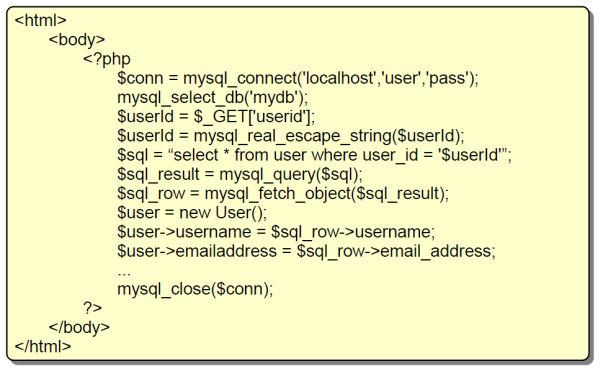
Old and Busted Code
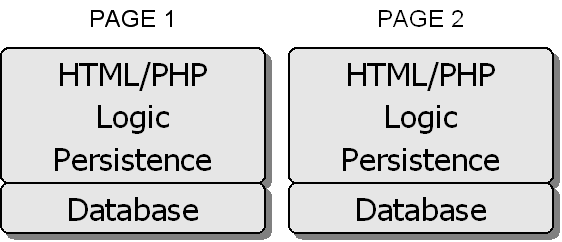
Old and Busted Design
- Core functionality duplicated across code
- Core functionality tied to presentation (HTML)
- How would another application access your innovative functionality?
New Hotness Development
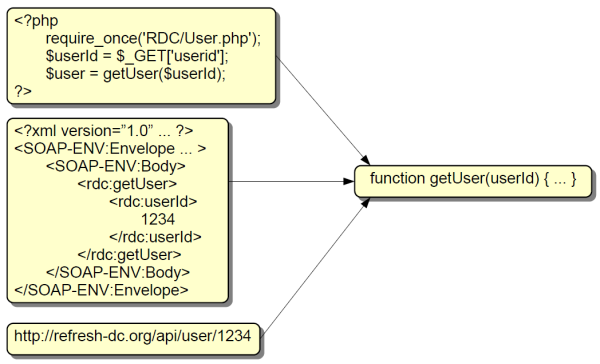
New Hotness Code
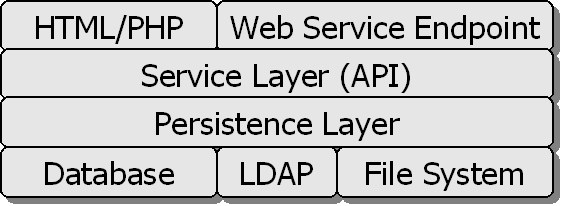
New Hotness Design
- Core functionality in a central location
- Presentation separate from functionality
- Calls to service methods provide functionality to you and other applications
Service-oriented design
- Safer modification of core functionality
- Simplifies future growth of the application
- Provides hooks for extensions
- Allows for simple addition of public API
But most importantly...
- Huge profits by jumping on service-oriented architecture bandwagon
- Street cred by jumping on Web 2.0 bandwagon
Should my app have an API?
- Depends on you, your goals, your infrastructure
- Benefits of public APIs:
- Builds goodwill with developers
- Allows for creation of new and innovative tools that utilize your app's data in new (and often unexpected) ways
- Allows for alternative input mechanisms: desktop apps, mobile apps, etc.